Farming practices across Africa have emerged mainly from traditions passed down from previous generations, and collective guesswork. Millions of farmers have looked at the changing colours of the sky to predict when the rains would fall, or felt the weight and texture of the soil to judge if it was healthy enough for the next planting season. While this deep, generational connection to the land kept families fed for generations, today’s agricultural challenges require something much faster and far more accurate. Unpredictable weather patterns caused by climate change, the skyrocketing cost of fertilisers, and a rapidly growing population mean that old methods are no longer enough to sustain the continent.
A quiet but powerful revolution is currently happening on African farms. Homegrown agricultural technology startups—commonly known as agritech startups—are stepping in to change the game. From the fertile fields of East Africa to the vast farmlands of West Africa and the maize belts of Southern Africa, young innovators are helping both smallholder and commercial farmers adopt precision agriculture and the Internet of Things (IoT).
Simply put, precision agriculture means giving crops and animals the exact amount of care, water, and nutrients they need—no more and no less. The Internet of Things refers to physical devices, such as sensors, automated water pumps, and drones, that are connected to the internet to collect, analyse, and share live data directly from the field. By blending these modern tools with local knowledge, agritech startups are cutting costs, increasing food production, and transforming farming from a risky gamble into a smart, predictable, and profitable business.
Smart Soil Testing
Historically, if a farmer in a rural community wanted to test their soil, they faced a long and frustrating process. They had to dig up samples, package them carefully, send them to a faraway laboratory in a major city, and wait weeks or even months for the results to come back. By the time the paperwork finally arrived, the ideal planting window had already passed. Because of this delay, many farmers simply bought whatever general fertiliser was available in their local markets, often pouring the wrong nutrients into their soil. This not only wasted precious money but also degraded the land over time.
Agritech startups are solving this major bottleneck by introducing instant soil intelligence platforms directly to rural communities. Instead of relying on distant labs, agents from these startups travel directly to farms equipped with portable, handheld devices that use light-reflection sensors, a process known scientifically as spectral analysis.
When the agent scans a soil sample, the device measures how light bounces off the dirt to determine its chemical makeup. Within minutes, the system processes this data and sends a simplified report or a text message directly to the farmer’s mobile phone. The message clearly explains the exact health status of the soil, pinpoints which specific nutrients like Nitrogen, Phosphorus, or Potassium are missing, and recommends the precise type and quantity of fertiliser to buy. This targeted approach keeps the soil healthy, protects nearby water sources from chemical pollution, and ensures that every bit of money spent on inputs directly improves the final harvest.
Solar-Powered IoT Irrigation (Saves Water and Energy)
Water is one of the most precious and poorly managed resources on the continent. In many regions, farmers are caught in a difficult cycle where they either wait on increasingly unpredictable seasonal rains or rely on expensive, polluting diesel generators to pump water from deep wells into their fields. When done manually, this often leads to overwatering or underwatering, both of which stress the crops and reduce the final yield.
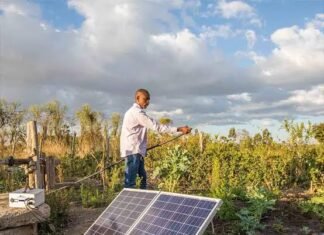
To solve this double challenge, agritech startups are deploying smart solar irrigation systems that combine the natural abundance of African sunshine with clever IoT sensors buried deep in the dirt. Pioneered by innovative companies like SunCulture in East Africa, these systems completely change how water is used.
Rather than pumping water blindly on a fixed schedule, the technology follows a strict data-driven sequence. The moisture sensors buried in the soil constantly monitor how dry the ground is. When the soil moisture drops below a certain level, the sensor sends a signal to a solar-powered water pump, which turns on automatically. The system then delivers water directly to the roots of the plants through high-efficiency drip irrigation pipes. Once the sensors detect that the ground has received enough water, the pump automatically shuts off. Farmers using this setup report cutting their water usage by up to 50 per cent while simultaneously doubling or tripling their crop yields, making it a true game-changer in arid and drought-prone regions.
Read Also: Nigeria’s Biggest Corporate Ventures Strategically Funding Agritech Startups
Drones Mapping Crop Health
As a farm grows larger, it becomes nearly impossible for a farmer to walk every single row of crops to check for early signs of disease or pest attacks. Often, by the time a severe problem like a locust invasion or a leaf fungus is visible from the edge of the field, it has already destroyed a massive portion of the harvest.
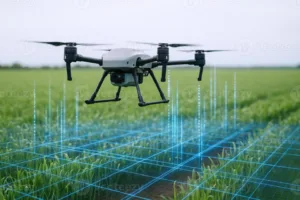
Image source: vasteezy.com
Agritech startups are taking to the skies to give farmers a bird’s-eye view of their land using commercial drones. These drones are equipped with specialised cameras and infrared sensors that can see things invisible to the human eye. As the drone flies over a field, it takes thousands of high-resolution photos that analyse the colour and light patterns reflecting off the plant leaves.
Startups use this aerial data to generate detailed health maps, often called prescription maps. Healthy plants reflect light differently from plants that are stressed by pests, disease, or lack of water. By looking at these maps on a smartphone, a farmer can pinpoint the exact cluster of plants that are suffering. Instead of spraying an entire ten-hectare farm with expensive and toxic pesticides, the farmer can walk directly to the troubled spot and treat only the affected area. This targeted approach dramatically lowers chemical costs, keeps food safer, and reduces the health risks for the labourers applying the treatments.
Localised Weather Monitoring
Standard weather forecasts broadcast on national television or radio are often too broad to be of any real use to a small-scale farmer. A rain forecast covering an entire region does not guarantee that rain will fall on a specific village, leaving farmers guessing when to sow their seeds or apply fertilisers, which can easily wash away in a sudden downpour.
To provide a hyper-local solution, agritech startups are installing affordable, IoT-powered weather stations right inside rural communities. These compact, durable stations continuously measure local rainfall, humidity, temperature, and wind speed.
The collected data is then combined with global satellite imagery using smart computer software to create highly accurate, hyper-local forecasts. Instead of receiving a generic update, farmers get text messages or automated voice notes in their own local languages, sent directly to their mobile phones. These alerts inform them of the exact days to plant, warn them of approaching storms, and advise them on the best times to harvest. This direct, localised communication gives communities a reliable shield against the unpredictable swings of climate change.
Smart Collars for Livestocks on the Pasture
The agritech revolution is not limited to crops; it is also making waves in livestock farming and pastoralist communities across the Sahel and East Africa. For pastoralists, losing cattle to disease, theft, or dehydration during long treks in search of water can destroy a family’s entire life savings overnight.

Image source: Shutterstock
Agritech startups are addressing this vulnerability by introducing smart, solar-powered IoT collars that are placed around the necks of cattle. These durable collars use GPS tracking to monitor the exact location of the herd in real time.
Beyond tracking location to prevent theft, the collars contain motion and temperature sensors that monitor the animal’s behaviour and body temperature. If a cow stops moving normally or shows signs of a fever, the system immediately sends an alert to the herder’s phone. This allows the livestock owner to isolate the sick animal and call a veterinarian before a contagious disease can spread through the entire herd. Furthermore, precision dairy systems track milk production against feed intake, helping farmers optimise the exact amount of nutrition each animal needs to stay healthy and productive.
Bypassing the Middlemen Through Digital Access to Fair Markets
For generations, one of the biggest headaches for African farmers has been selling their harvest at a fair price. Because rural farms are often isolated from major cities, farmers have historically relied on informal middlemen who travel from village to village buying produce. These middlemen frequently take advantage of the farmer’s isolation, buying high-quality crops at extremely low prices and selling them for massive profits in urban markets.
Agritech platforms are fundamentally breaking this cycle by using IoT data to build direct digital marketplaces. Startups like ThriveAgric in Nigeria and various digital hubs in East Africa allow farmers to log their expected harvest volumes and crop quality directly into an app.
A tomato or maize farmer can use a smartphone to upload data regarding the size, ripeness, and quantity of their upcoming harvest. The platform automatically matches this data with large buyers, including food processors, supermarkets, and international exporters, bypassing exploitative middlemen entirely. To build deeper trust, some platforms use blockchain technology paired with IoT tracking devices on transport trucks. This allows a buyer in Europe or a major African city to trace a box of fruit all the way back to the exact farm it was grown on, ensuring absolute transparency and helping African farmers secure premium prices on the global stage.
Attracting the Youth and Opening Financial Doors
Historically, banking institutions across Africa have viewed smallholder agriculture as a highly risky sector. Because small farms rarely kept written financial records or predictable yield data, banks routinely denied them loans, leaving farmers unable to afford high-quality seeds, modern tools, or solar pumps.
The data collected by precision tools and IoT devices is completely shifting this financial dynamic. By tracking a farm’s soil health, water usage, and exact harvest history over several seasons, agritech startups can generate a digital “credit score” for the farmer.
When a farmer can present verified, independent data showing consistent yields and smart resource management, local banks and microfinance institutions are far more willing to provide credit, loans, and affordable crop insurance. This newfound access to capital allows smallholders to grow their operations sustainably.
Critically, this high-tech shift is also making agriculture highly attractive to Africa’s educated youth. Rather than abandoning rural areas to search for crowded city jobs, young Africans are finding lucrative careers right at home. They are entering the agricultural sector as drone operators, data analysts, software developers, and field technicians, injecting fresh energy and modern business thinking into rural economies.
Overcoming the Hurdles of Rural Tech Adoption
Despite the massive benefits, scaling these technologies across rural Africa is not without serious hurdles. Deep in the countryside, mobile network connectivity can be highly unstable, electricity grids are often nonexistent, and the initial cost of purchasing smart hardware remains too high for a family living on subsistence wages. Additionally, language barriers and low digital literacy can make farmers hesitant to trust software recommendations over traditional practices.
Agritech startups are actively designing their way around these constraints with clever, localised strategies. To tackle the cost barrier, many companies operate on a pay-as-you-go model or a shared-service structure. Instead of buying an expensive drone or a weather station, a village can rent a drone service for a single afternoon or split the cost of a community sensor package.
Furthermore, engineers are designing devices that run entirely on solar energy and can process data locally without needing a constant internet connection. To bridge the literacy gap, platforms are moving away from complex text menus, relying instead on simple voice messages recorded in local dialects and utilising clean, visual graphics that make data easy to understand at a single glance.
Read Also: How Startups Can Thrive Doing Vertical Farming In Nigeria
Merging Generational Wisdom with Modern Tools
It is vital to understand that agritech startups are not trying to wipe away traditional farming practices. Instead, the most successful innovations are those that respectfully combine the deep, historical wisdom of elder farmers with the absolute accuracy of modern tools.
An experienced elder’s understanding of local soil behaviour and seasonal shifts is incredibly valuable. When that traditional knowledge is backed by real-time data from an underground moisture sensor or an overhead drone flight, the results are unmatched.
As Africa’s population continues to grow at a rapid pace, the demand for food will only intensify, even as usable farmland faces severe pressure from climate change and expanding cities. Precision technologies and IoT adoption offer a proven, practical path to producing far more food on the same piece of land while actively protecting the continent’s natural resources. By turning farming into a data-driven, resilient enterprise, Africa’s young agritech innovators are helping to build a highly secure, prosperous, and self-reliant food future for millions of families across the continent.