Running a tech startup or any modern company requires a constant, stable stream of electricity. Computers must remain turned on, internet routers require continuous power, and servers cannot afford prolonged downtimes. In Nigeria, however, relying on the central national electricity grid is a major gamble. The country’s national power grid collapses multiple times a year, resulting in massive blackouts that span states and regions. Worst still, frequent and unexplained power outages often leads to prolonged blackouts, and this lack of steady electricity is a massive hurdle to growth of startups in Nigeria.
However, in the midst of these daunting challenges, Nigerian founders and their teams are showing great resilience. They are actively finding creative, modern, and sometimes costly ways to beat the blackouts. Rather than waiting for a government solution that’s not forthcoming, startups in Nigeria are taking their power needs into their own hands to ensure they stay connected to the global digital economy.
The Shift From Expensive Fuel to Clean Green Energy
For a very long time, the standard backup plan for any Nigerian startup or business was a fuel-powered generator. Large companies relied on heavy diesel generators to power entire office blocks, while small shops used smaller petrol generators. Today, however, the situation has changed completely. The cost of petrol and diesel has gone up so significantly that running these generators all day has become too expensive for any startup in Nigeria to survive on.
To stay afloat, startups in Nigeria are turning heavily to solar energy. Walking through popular tech co-working spaces and startup headquarters today, one will see rooftops covered with dark solar panels. These systems capture the abundant Nigerian sunlight during the day and store the electricity in large, modern lithium-ion batteries. This shift has also opened up a massive market for solar energy-tech startups like Sun King and Arnergy, which design solar power systems specifically for homes and offices. Because buying solar panels and large batteries at once is very expensive, these energy startups allow other businesses to pay in small monthly instalments using their mobile phones. This “pay-as-you-go” system has made it possible for small tech companies to ditch the national grid completely and rely on clean, reliable sun power.
The Rise of Shared Tech Hubs and Co-working Spaces
Not every startup in Nigeria can afford to install a private solar power grid or maintain a large industrial generator. For small teams of two to five people, renting a whole office building and managing the utility bills on their own is a quick way to go bankrupt. This financial challenge has made co-working spaces and tech hubs highly popular across major Nigerian cities. Spaces like CcHub, Leadspace, and various neighbourhood innovation hubs act as lifeline for many startups in Nigeria.
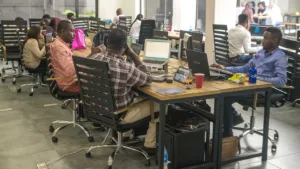
Image source: The Guardian Nigeria News
When a founder rents a desk or a small private office in a tech hub, they are not just paying for a physical chair and table. They are primarily paying for guaranteed, uninterrupted power and high-speed internet. These hubs usually combine multiple energy sources to ensure the lights never blink. They might use solar energy during the morning, switch to the national grid if electricity flows from the government lines, and turn on a large diesel generator as a last resort. By sharing the high cost of this energy mix among dozens of different small companies, tech hubs make it highly affordable for early-stage startups in Nigeria to enjoy twenty-four-hour power.
Adopting Remote Work and Distributing the Energy Burden
Another clever strategy used by Nigerian startups is changing how and where their staff work. During the global pandemic, many companies discovered the power of working from home. In Nigeria, tech founders are using remote work specifically to handle the local electricity crisis. Instead of gathering thirty people in a single large office building that requires a massive, expensive generator to cool down rooms and power equipment, startups let their workers stay at home.
The startup then provides each employee with a small monthly “power allowance” or “light stipend.” Employees use this money to buy fuel for their personal small generators or to buy subscription plans for mini-solar home systems. Some startups go as far as buying small inverter systems or rechargeable power banks for their key software developers and customer support agents. This strategy distributes the energy risk. If power fails in one part of Lagos, a worker living in another part of the city can keep the company running, ensuring that the business never goes completely offline.
Designing Light Software That Saves Laptop Battery
The electricity crisis has also changed how Nigerian engineers write computer code and design software applications. When an office or a home is running on battery power or a small generator, every single watt of electricity counts. Laptops drain their batteries much faster when running heavy software, and bad internet connections force computers to work twice as hard. Therefore, Nigerian software developers are now focusing on building “lightweight” systems.
They build mobile apps that do not consume too much internet data and do not drain phone or laptop batteries quickly. They also optimise their cloud servers to handle tasks efficiently so that staff do not need to sit in front of a computer for six hours waiting for a system report to compile. By making the technology itself highly efficient, workers can finish their daily duties quickly and shut down their computers before their laptop batteries run dry.
Building Offline Systems for Field Operations
Some startups are adapting not only their power hardware but also how their software functions in the real world. For example, logistics startups that help delivery drivers find home addresses realised that their drivers often work in areas with no electricity to charge their phones. To solve this, companies are building mobile apps that can work completely offline.
The driver saves the delivery information while the phone is on, and even if the battery dies or there is no network signal, the app keeps tabs of the addresses using local storage. Later, when the driver reaches a charging point or finds electricity, the app automatically sends all the completed delivery data back to the main office server. Similar innovations are happening in the agriculture and retail tech sectors, where data is saved locally on mobile devices and synced only when stable power and internet return.
Shifting Working Hours to Match Power Trends
A very simple but highly effective adaptation is changing the official working hours of the team to match when electricity is usually available. Some startups have noticed that the national grid supply in their specific neighbourhood is often available late at night or very early in the morning. Instead of fighting this unpredictable pattern, they adjust their company schedules to take advantage of it.
For instance, a content creation startup might ask its video editors to work from ten o’clock at night to six o’clock in the morning, when the local power supply is more stable and less likely to drop. Customer service teams might work in two distinct shifts, with the first shift starting very early before the morning power cut happens. This approach costs almost nothing in terms of equipment but requires flexibility from the workers. Many young Nigerian workers welcome such arrangements because it also allows them to avoid heavy city traffic.
Forming Street-Level Power Cooperatives
In some busy business districts, startups have formed small energy cooperatives to solve their power problems together rather than fighting the battle alone. On a single street, there might be five or six different startups operating out of different buildings. In the past, each business ran its own small generator, creating a lot of noise, smoke, and high individual fuel costs.
Today, these businesses are entering agreements to share a single, larger, more efficient generator and a joint solar farm. They run shared power lines from a central point directly into each separate office. They then split the fuel and maintenance costs according to how much power each startup actually consumes. This cooperative method reduces costs for everyone because larger generators are much more fuel-efficient than five small ones running at the same time. It also allows them to hire a single technician to keep the shared system running smoothly.
Growing Support From Governments and Investors
The Nigerian government and the private financial sector have started to notice these difficulties faced by startups in Nigeria, and are stepping in to help. Through the Nigerian Rural Electrification Agency, some grants and low-interest loans are now being made available for startups to buy solar equipment. A few startup hubs have received direct support to install localised mini-grids that serve many companies at once.
Read Also: iDICE and Startup Bridge: Nigeria’s Twin Programs Supporting Startup Scaling Operations
Furthermore, banks and venture capital firms that lend money to startups are now more willing to give specific loans for power equipment because they recognise that without stable electricity, a business cannot survive to pay back its debts. In fact, some international investors now ask African startups to show their official backup power plan before they agree to invest money in the company.
The High Economic Cost of Survival For Startups In Nigeria
While these adaptation strategies show the amazing, unstoppable spirit of Nigerian entrepreneurs, they come with a very heavy financial price. Money that a tech startup should normally use to hire more software engineers, improve product design, or market their services to new customers is instead spent on buying heavy batteries, replacing inverter parts, and purchasing fuel.
This makes running a technology startup in Nigeria much more expensive than running the same business in countries with stable infrastructure. Experts note that many big companies and smaller tech firms are actively stepping off the national grid entirely to use independent “captive power.” This is a tough, expensive choice, but for these startups, it is currently the only way to ensure that a sudden nationwide blackout does not erase their hard work or suddenly disconnect them from their global clients.
An unstable power supply remains one of the most serious problems facing businesses in Nigeria today. However, as the local tech ecosystem shows, it is no longer a reason to give up on a dream of founding a startup in Nigeria. While the ultimate goal remains a completely stable national grid for every citizen, these innovative startups in Nigeria are successfully building a parallel system to afloat and remain in business.