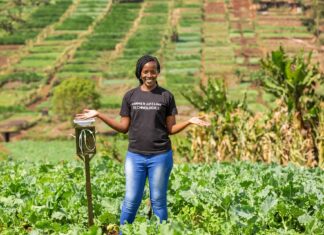
A young Kenyan agritech and fintech startup, Grofunder Africa, has developed an AI-powered platform that channels financing to smallholder farmers through agricultural inputs rather than cash, partnering with licensed lenders and leveraging farmer cooperatives. The company positions itself as a bridge between capital in urban financial institutions and fragmented rural producers long locked out of formal credit.
Grofunder Africa operates as a peer-to-peer style lending and investment platform focused on Kenya’s small-scale farmers.
TechPolyp spoke with Kelvin Dol, co-founder and CEO of Grofunder Africa, about the company’s origins, technology stack, risk management approach, impact metrics, and his advice for early-stage African founders.
In a recorded interview, Dol confirmed his consent for TechPolyp to use relevant portions for editorial content, written articles, videos, and social media clips. He described the company as having launched in July 2025 to tackle the near-nonexistent access to financing for African smallholder farmers.
From Bank Rejections to a New Financing Model
Grofunder Africa was born from an observation that traditional lenders routinely reject agricultural financing because farmers lack collateral, formal credit histories, and documented income records. Smallholder farmers are also highly fragmented, making them expensive to find, onboard, and monitor. Banks simply avoid the cost and perceived risk.
That insight was further enriched by the painful experience of Dol’s co-founder, Melanie Namukuru, who faced multiple bank rejections while trying to expand her own farming operations. The pair set out to solve the problem not by becoming another lender themselves, but by creating infrastructure that lets existing capital reach farmers more effectively
Early pilots connected individual retail investors with farmers. The company later pivoted. Dol explained that Grofunder Africa now works primarily with local licensed lenders that already hold capital but struggle to reach smallholders at scale. According to Dol, his startup Grofunder Africa has signed a partnership with Honey Capital and is in discussions with two other local banks, with a target of reaching 3,000 farmers within six to twelve months.
How Grofunder Africa Works
Rather than disbursing cash, the platform provides agricultural inputs—seeds, fertilisers, and insurance—on credit. This approach reduces the risk of funds being diverted and ties financing directly to productive activity.
The technology is organised in four layers. The first is farmer data and credit intelligence: alternative data such as production history and cooperative transaction records stand in for traditional collateral and bank statements. The second is end-to-end loan management, allowing urban-based banks to disburse, vet, and collect loans without building rural branches. The third is cooperative management: by partnering with existing farmer cooperatives, the company sharply reduces customer acquisition and monitoring costs. The fourth involves remote monitoring, including the integration of satellite imagery to track planting, fertiliser application, and harvesting while also delivering agronomic advice—replacing the need for frequent drone or physical inspections.
AI-powered credit scoring is still under development and is expected to take six months to a year of training before full deployment. Once deployed, the credit-scoring AI models will draw on the alternative data layers already being collected. Satellite imagery is being layered in to give both lenders and farmers clearer visibility into field-level activity. A WhatsApp-based digital agronomy chatbot and field agents who can respond within 24 hours provide additional support when problems arise.
Mitigating Defaults Through Social Capital
When asked how the company handles defaults, Dol pointed first to cooperatives and social capital rather than pure algorithms. For seasonal crops such as coffee, income gaps between harvests create natural repayment pressure. Grofunder Africa uses a check-off system with cooperatives so that a percentage of the farmer’s revenue is deducted at the point of produce delivery and applied to the loan.
The company also works with digitised table-banking groups rooted in long-standing African peer-accountability traditions—Dol claimed. Group members co-sign and guarantee loans; peers step in when a neighbour struggles with an instalment. This combination of institutional processes and community pressure is the primary default buffer.
Defining the Ideal Farmer Profile for Grofunder Africa
The target customer has narrowed over time. Early efforts focused on small commercial farmers working less than five acres. Experience showed that the real exclusion was deeper. The refined profile centres on subsistence and near-subsistence farmers cultivating two to three acres or less who belong to a table-banking group, are members of a farmer cooperative, and can show active produce delivery records over the previous twelve months. These are farmers completely outside formal financial infrastructure.
Challenges and Bottlenecks Involved in Running Grofunder Africa
Operational and regulatory hurdles have been significant. Dol’s advice to other founders is to fall in love with the problem rather than any single solution. Early pilots of Grofunder Africa exposed weather vulnerabilities that forced model changes.
According to Dol, regulatory compliance proved especially demanding. Obtaining a Central Bank of Kenya lending licence requires substantial capital and fees—potentially $100,000 to $200,000. Grofunder Africa bypassed that barrier by partnering with already-licensed institutions rather than seeking its own licence.
Farmer mindset is another persistent challenge. Many producers are accustomed to grants or free inputs from NGOs and government programmes and are surprised to learn that loans must be repaid. Continuous education and training form part of the operating model.
Fundraising presents the classic early-stage chicken-and-egg problem; investors demand traction, yet traction requires cash—Dol noted.
Measuring Impact and Building Climate Resilience
Impact is tracked through increases in agricultural production on financed land, household income changes over six-month periods, and financial inclusion indicators such as first-time loan access. One early example cited by Dol is a young farmer named Wonga who turned a $40 input loan into $220 in revenue within four months. Demographic data from recent cooperative cohorts shows strong participation by women—around 80 per cent in one group.
Climate risk is addressed by embedding crop insurance into the input loans. If a farmer loses a harvest to floods, drought, or pests outside their control, the insurance covers the loan so the producer is not left with debt and no crop. Field agents and the agronomy chatbot provide rapid response when damage occurs.
Awards, Traction, and Ambition
Despite its short history, Grofunder Africa has already collected external validation. The company won the overall Verto Business Award when it was less than six months old and placed as first runners-up in the fintech track at the Africa Connect Summit innovation awards. Dol views these recognitions, together with early lending metrics, as useful confirmation of the model and as fuel for the founding team.
Looking ahead, the twelve-month plan centres on completing AI credit scoring, rolling out satellite monitoring, and reaching 3,000 farmers. The three-year target is 15,000 farmers. Within five years the company aims to serve more than 100,000 farmers across two or three additional African countries. Dol has said the team has done the maths and believes three years of growth can be compressed into twelve months under the right conditions. According to Kelvin Dol, a visit to farmers in Nigeria by the Grofunder Africa team is already being planned.
Read Also: Co-founder and CEO Teniola Adedeji is Reshaping Medicine Delivery in Nigeria with Pharmarun
Key Lessons for African Founders
Dol’s advice is first, fall in love with the problem; the solution will change. Grofunder Africa’s model shifted three or four times in its first year. Intimate understanding of users makes those pivots possible.
Second, surround yourself with a team that genuinely believes in the work. Motivation is a finite resource, and the entrepreneurial path is often lonely.
Third, build on real customer feedback rather than assumptions. Founders who design for themselves instead of for paying users usually fail.
Fourth, do not try to build everything. Strategic partnerships—whether for payments, capital, or distribution—are essential. There is little value in reinventing a payment gateway when reliable ones already exist.
An Analysis of Africa’s Smallholder Financing Gap
Africa’s smallholder farmers produce the majority of the continent’s food yet remain largely shut out of formal credit. Estimates place the annual financing gap for smallholders at around $75 billion. Only about 6 per cent of African smallholder farmers currently access formal credit, and banks channel a very small share of their lending—often cited in the low single digits—toward small-scale agriculture. The barriers are structural and include lack of collateral, thin credit histories, high transaction costs of serving dispersed rural clients, and climate volatility.
The solution is not simply to lend more money to smallholder farmers. It is to create infrastructure that lowers the cost of serving these farmers, improves risk assessment through alternative data, and embeds repayment into existing social and commercial structures such as cooperatives and produce delivery. Platforms like Grofunder Africa are attempting to do exactly that by combining input financing, cooperative partnerships, satellite monitoring, and (soon) AI credit scoring while partnering with licensed capital providers rather than competing with them.
The deeper challenge is behavioural and institutional. Farmers must shift from a grant mentality to a credit culture. Lenders must accept alternative data and social collateral. Technology must fit existing workflows rather than force wholesale operational change. Trust is built slowly, and value must be visible early—whether through higher yields, smoother cash flow, or protection against climate shocks. If models that combine technology, cooperatives, and institutional capital can scale, they stand a chance of turning one of Africa’s largest financing gaps into a more productive and resilient agricultural system.
About Grofunder Africa
Grofunder Africa is a Kenyan agritech and fintech company founded in 2025. It operates an AI-powered platform that provides smallholder farmers with agricultural inputs, insurance, and financing through partnerships with licensed lenders and farmer cooperatives. The model emphasises alternative data, cooperative risk-sharing, satellite monitoring, and climate resilience. The company is based in Kenya and is currently focused on scaling within the country before expanding regionally.
About Kelvin Dol
Kelvin Dol is the co-founder and CEO of Grofunder Africa. A trained accountant with experience in operations and supply-chain management, he co-founded the company with Melanie Namukuru after observing the persistent exclusion of smallholder farmers from formal finance. He credits his co-founder with motivating him through the difficult early stages of building the startup.
Full Hyperlink Map for the Grofunder Africa Editorial Article
Company & Founders
Grofunder Africa
https://ke.linkedin.com/company/grofunder-africa
Official LinkedIn companyage (best current public presence)
https://grofunder.odoo.com/
Company website / waitlist page
Kelvin Dol
https://www.wearetech.africa/en/fils-uk/tech-stars/kenyas-kelvin-dol-connects-retail-investors-with-farmers-through-grofunder
Best profile + interview feature
Kelvin Dol, co-founder and CEO
https://www.wearetech.africa/en/fils-uk/tech-stars/kenyas-kelvin-dol-connects-retail-investors-with-farmers-through-grofunder
Same as above
Melanie Namukuru / co-founder Melanie Namukuru
(No strong public profile found)
Recommend linking to company LinkedIn or omitting personal link for now
Honey Capital
(Limited public results)
Leave unlinked or note as local licensed lender
Awards & Recognition
Anchor Text / Phrase
Suggested URL
Notes
Verto Business Award / Verto Awards
Primary announcement of overall win
Verto Awards
Strong secondary coverage
first runners-up in the fintech track at the Africa Connect Summit
(No strong public URL located)
Leave unlinked or seek internal confirmation
Market Statistics & Context
Anchor Text / Phrase
Suggested URL
Notes
$75 billion annual financing gap / USD 75 billion financing gap
https://www.kenyanews.go.ke/closing-the-financing-gap-for-africas-smallholder-farmers/
Recent AfDB-aligned figure
$75 billion
https://www.afdb.org/en/news-and-events/experts-urge-stronger-collaboration-boost-smallholder-farmer-financing-82008
Official AfDB context
only about 6 percent of African smallholder farmers currently access formal credit
https://www.kenyanews.go.ke/closing-the-financing-gap-for-africas-smallholder-farmers/
Directly supports the 6% figure
banks channel a very small share of their lending… toward small-scale agriculture
https://www.kenyanews.go.ke/closing-the-financing-gap-for-africas-smallholder-farmers/
https://www.wearetech.africa/en/fils-uk/tech-stars/kenyas-kelvin-dol-connects-retail-investors-with-farmers-through-grofunder
Mentions satellite + monitoring
agricultural inputs on credit
https://www.wearetech.africa/en/fils-uk/tech-stars/kenyas-kelvin-dol-connects-retail-investors-with-farmers-through-grofunder
Core model description
peer-to-peer lending / P2P
https://ke.linkedin.com/company/grofunder-africa
Company self-description
Supporting / Contextual Links (Optional but Useful)
Anchor Text / Phrase
Suggested URL
Notes
African Development Bank / AfDB
https://www.afdb.org/
Institutional source for financing gap data
smallholder farmers
https://www.afdb.org/en/news-and-events/experts-urge-stronger-collaboration-boost-smallholder-farmer-financing-82008