Drone technology is advancing rapidly across Africa, and in Nigeria particularly. Founders and startups are using unmanned aerial vehicles, commonly known as drones, to address challenges like spraying fertilisers on farms, delivering emergency medical supplies to remote villages, film high-quality Nollywood movies, and monitor multi-million-dollar infrastructure projects.
However, because the sky is a shared space, flying a drone for business is not as simple as buying a device and taking off. The federal government has put strict rules in place to ensure that these flying machines do not crash into passenger aeroplanes or compromise national security. For any Nigerian tech founder or startup operator, understanding the policy environment is just as important as building the technology itself.
The Regulators in Charge of the Nigerian Sky
To operate a drone business safely in Nigeria, a startup must deal with two major government bodies. The first and primary regulator is the Nigerian Civil Aviation Authority, which is known as the NCAA. The NCAA makes the civil aviation rules, certifies pilots, and ensures all aircraft follow safety protocols.
The second body is the Office of the National Security Adviser, widely called ONSA. Because drones carry cameras and can fly into restricted areas, the security agencies treat them with caution. ONSA handles the security clearances and monitors the importation of this technology to make sure it does not fall into the hands of criminals. A startup cannot legally fly a commercial drone without approvals from both the NCAA and ONSA.
Understanding the Categories of Drone Operations
The government does not treat a tiny toy drone the same way it treats a massive drone carrying fifty kilograms of agricultural products. Under the latest civil aviation regulations, drone usage is broken down into three operational categories based on weight and the level of risk involved.
The first is the Open Category. This is strictly for recreational use and hobbyists who fly small, light drones for fun. Startups rarely operate here because commercial activities are generally excluded from this low-risk tier.
The second is the Specific Category. This is where most Nigerian startups operate. It covers small to medium-scale commercial activities, including aerial wedding photography, media coverage, mapping, and precision farming. Drones in this tier usually weigh between twenty-five and one hundred and fifty kilograms. To operate here, the startup must be registered as a corporate business entity in Nigeria.
The third is the Certified Category. This tier is reserved for high-risk, large-scale industrial operations using heavy drones weighing one hundred and fifty kilograms and above. This includes heavy cargo delivery, international flights, or flying drones over large crowds of people. The rules here are just as tough as those for running a commercial airline.
The Essential Steps to Compliance
To make things easier for the growing industry, the NCAA launched a digital portal specifically for drone registration and compliance tracking. Startups must now follow a clear sequence of steps before their fleet can touch the sky.
The first step is securing a security clearance and an End User Certificate from the Office of the National Security Adviser. This certificate proves that the drone belongs to a legitimate business and will be used for lawful purposes.
Once the security clearance is obtained, the startup can log into the digital aviation portal to register the drone equipment. During registration, the business must provide the drone’s serial number, specifications, and company details.
After registration, commercial operators must complete a comprehensive certification process to obtain a Remotely Piloted Aircraft Systems Operator Certificate. This certification process involves passing through several administrative phases, which include formal document evaluations and practical demonstrations to prove that the company knows how to manage safety emergencies. The certificate is renewable every five years.
Everyday Flying Rules and Restrictions
Even after getting all the certificates, drone pilots must obey daily operational safety rules. By law, drones must not be operated recklessly or in a way that endangers people, property, or traditional manned aeroplanes.
Pilots are expected to keep their drones at a height of four hundred feet or less above the ground. They must also maintain a direct line of sight with the aircraft at all times, meaning the pilot should be able to see the drone clearly with their naked eyes while flying it.
Furthermore, flying near airports, military barracks, government houses, or dense crowds of people without special, separate permissions is strictly illegal. Commercial drone operators are also required to submit their flight plans to aviation authorities ahead of time so that air traffic controllers know exactly who is in the sky.
Read Also: Flying Labs: The Angolan Startup Improving Agriculture and STEM with Drones and AI
Privacy Rights and Personal Data Protection
One area where startups frequently get into trouble is data privacy. Because commercial drones are almost always equipped with powerful high-definition cameras and sensors, they can easily capture images of people and private properties without permission.
The regulations make it clear that drone operators must respect individual privacy rights. A drone business cannot legally film or conduct surveillance over a person’s compound or private facility unless they have obtained explicit consent from the owner, or if they are doing so under specific news-gathering allowances. Startups should ensure their flight paths avoid residential windows and backyard spaces to prevent costly legal battles over privacy violations.
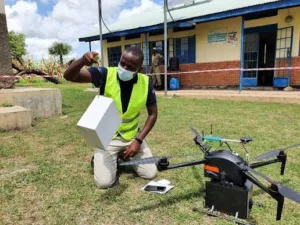
Image source: Makerere University, Kenya
Penalties for Operating Illegally
The federal government takes airspace violations very seriously. Flying a commercial drone without the proper registration, security clearance, or operator certificates carries heavy consequences.
If a startup is caught violating the rules, the law allows aviation authorities to completely seize the expensive drone equipment. In addition to losing their hardware, company executives and pilots can face heavy financial fines or criminal prosecution leading to jail time. Taking a shortcut is simply not worth the risk of shutting down the entire business.
The Future of Drone Tech and Policy Support
While the rules may look strict, the government is actively adjusting its approach to support technology growth. Drones have now been fully integrated into the broader National Aviation Master Plan, showing that Nigeria views unmanned aviation as a key driver of the digital economy.
The introduction of online portals and regular stakeholder dialogues means that the regulatory environment is becoming more business-friendly over time. For startups that take the time to follow the rules, obtain their security clearances, and train their pilots properly, the Nigerian airspace offers massive, legal commercial opportunities. Taking compliance seriously is the best way to build a sustainable tech brand that can attract international investors and transform the African continent.
You might find it helpful to read How Agritech Startups are Leveraging Through Precision Technology and IoT Adoption which shows how young innovators are building and deploying drones and other technologies within Africa’s evolving Agritech ecosystem.