
Most African countries are facing a common problem of giving good education to every child, especially those in remote areas and poor neighbourhoods. The problem is big because many schools lack essentials such as desks, books, clean water and qualified teachers. Some classes have one hundred students but only one teacher. Together, these problems have resulted in a great learning gap in the continent.
But today, a powerful solution is rising across the continent. Young companies called EdTech startups (Education Technology startups) are using mobile phones, computers, and the internet to change how African children learn. They are not waiting for governments to build more schools. Instead, they are putting a classroom inside every student’s pocket.
Why Learning is Challenging for Many Africans
Before we see the solution, we must understand the problem clearly. In sub-Saharan Africa, nearly nine out of every ten children cannot read and understand a simple story by age ten. This is not because they are not smart, but due to problems such as:
- Too few teachers: Many countries do not have enough trained teachers. One teacher may have to handle three or more different courses in one school.
- No textbooks: A single textbook may be shared by five or six students.
- Long distances to school: In rural areas, a child may walk two hours to reach school, and then walk two hours back home.
- High costs: Even when school fees are low, families cannot afford uniforms, pens, or exercise books.
Because of these problems, millions of young Africans are left behind. But EdTech startups saw a chance to help.
The Tool That Changes Everything: The Mobile Phone
Africa has one big advantage. Even in poor villages, many families have a smartphone or a simple mobile phone. Mobile data is becoming cheaper. This means that learning no longer has to happen only inside a school building. It can happen on a farm, on a bus, or at the kitchen table.
EdTech startups use this reality to send lessons, quizzes, and even live teachers directly to students. They bypass the old problems of crowded classrooms and missing textbooks.
How EdTech Startups Are Bridging the Gap (With Examples)
Let us look at the specific ways these startups are working across Africa.
1. Teaching in Local Languages
Many African students struggle because school is taught in English or French, but at home they speak Yoruba, Swahili, Hausa, or Zulu. EdTech startups noticed this problem. They now create apps and videos that teach mathematics, science, and reading in local languages.
Example: In Nigeria, a startup called uLesson offers short video lessons in a mix of English and local explanations. A student in Kano can watch a science experiment on their phone, explained in a way that feels familiar. This makes hard subjects easy to understand.
2. Giving Every Student a Personal Tutor
In a crowded class, a teacher cannot stop to explain something five times for a slow learner. But an app can. EdTech platforms use adaptive learning —meaning the app watches how the student answers questions. If the student fails a maths problem, the app gives easier questions first, then slowly increases difficulty. It acts like a private tutor.
Example: In South Africa, Siyavula offers practice questions in maths and science. The app gives instant feedback. If you get an answer wrong, it shows you the correct steps right away. This helps students learn from their mistakes without feeling ashamed in front of classmates.
3. Reaching Students in Remote Villages
The Internet is not always available in remote areas. Some startups solved this by creating offline content. Students download lessons when they go to a nearby town with internet, and then study offline at home for weeks.
Example: In Kenya, Eneza Education works on even the simplest phones. A student sends a text message (SMS) with a question, and receives a lesson or quiz back by SMS. No internet is needed. This is brilliant for villages where only basic phone networks exist.
4. Training and Supporting Teachers
EdTech not only help students. It also helps teachers become better. Many teachers in Africa have never received proper training. Startups now offer affordable courses for teachers on their phones. Teachers learn new methods, get lesson plans, and even receive certificates.
Example: In Ghana, Mighty Africa trains teachers through mobile videos and group chats. A teacher in a rural school can watch a model teacher explain fractions, then try the same method in their own class the next day.
5. Making Learning Fun and Rewarding
Many African children drop out of school because they find lessons boring or too hard. EdTech startups use games, points, and badges to make learning exciting. Students earn stars for completing quizzes. They compete with friends on leaderboards. This turns studying into something they want to do.
Example: In Rwanda, Zemi Learning uses tablets with educational games. Children solve puzzles to learn English and maths. The more they play, the more they learn. Parents report that children now ask to study instead of being forced to study.
What EdTech Is Changing Africa’s Mode of Learning
These efforts are not just ideas. They are working. In countries where EdTech has been adopted, test scores are rising. More students are passing national exams. Dropout rates are falling.
- In Kenya, students using Eneza improved their exam scores by an average of 15 per cent.
- In Nigeria, uLesson users reported better understanding of science subjects within just two months.
- In South Africa, Siyavula helped thousands of students pass matric maths who would have failed before.
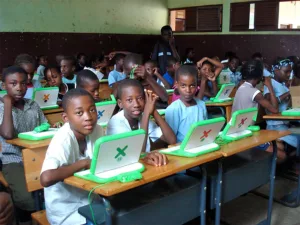
Image source: Digitizeafrica.com
Governments are noticing Edtech’s impact and some countries are now giving tablets to primary school pupils. Others are adding EdTech apps to their national curriculum.
Also, Read: Vast Opportunities Awaiting Recycling-Tech Startups As Waste Mounts Across Nigeria
Challenges That Remain
Even with all this progress, some problems still. Some include:
- Electricity: In very remote areas, phones run out of battery and there is no power to recharge them.
- Cost of data: Although data is cheaper, some families still cannot afford to download many videos.
- Parental support: Some parents do not know how to help their children use technology for learning.
- Device sharing: In poor families, one phone may be shared by three or four children, plus the parents and this can greatly limit a learner’s access to Edtech platforms.
However, startups are solving these challenges too. Some sell solar-powered chargers. Others compress their videos to use very little data. Some work through community centres where children can gather to use one tablet together.
What the Future Holds
The future of learning in Africa is bright. Analysts say the EdTech market in Africa will grow very fast over the next five years. We will see more artificial intelligence that adapts to each child’s pace. We will see virtual reality that lets a student in a village walk through a science lab in London. We will see more partnerships between governments and startups to give free devices to poor families.
What Parents and Communities Can Do
If you are a parent, a teacher, or a community leader, you can help bridge the learning gap in the following ways:
- Find free or cheap learning apps in your local language. Many are completely free.
- Encourage your children to use their phones for studying, not just for social media or games.
- Form study groups where one phone or tablet is shared among five children.
- Talk to your local school about introducing mobile learning. Even one hour per day can make a difference.
The learning gap in Africa is real, and it has held back millions of bright young minds for too long. But EdTech startups are proving that where there is a mobile signal, there can be a school. They are giving second chances to students who dropped out. They are helping slow learners catch up, and are making education affordable, accessible, and even fun.
Africa can leapfrog—just like we skipped landline telephones and went straight to mobile phones. EdTech is that leap. And every child who learns to read, do maths, or speak English through a phone screen is proof that the gap can be closed.