
Mountains of waste on the roadsides is a familiar sight that greets the eye every morning across Nigeria. This growing pile of refuse has been a major source of pollution, blocking drains, and causing public health crises. However, a new narrative is taking root. Driven by smart policies, digital innovation, and a desperate need for environmental sanity, waste is rapidly transforming into one of Nigeria’s most valuable untapped resources. Vast opportunities await recycling-tech startups willing to take the plunge.
Understanding the Waste Crisis in Nigeria
To grasp the scale of the opportunity, one must first understand the sheer volume of the problem. Nigeria generates an astonishing volume of solid waste daily. In Lagos, Africa’s most populous city, the numbers are staggering. According to the Lagos Waste Management Authority, the state generates over 13,000 metric tonnes of waste every day, contributing to a national figure of nearly 87,671 tonnes daily. To put this in perspective, experts note that Nigeria accounts for roughly 2.5% of the entire world’s waste output.
The opportunity lies in what happens to this waste. Currently, the formal waste management system handles less than half of the waste generated in states like Lagos. The rest ends up in illegal dumpsites, open gutters, or is burned, releasing harmful toxins into the air. Official reports estimate that nearly 40% of this rubbish is recyclable—materials like plastics, aluminium, glass, and cardboard—yet currently, no more than 12% is retrieved from the waste stream. Additionally, over 55% of the waste is organic, which can be converted into valuable compost or biogas.
This gap between the huge amount of waste produced and the tiny fraction that is recycled represents a multi-billion-dollar economic vacuum. The United Nations Industrial Development Organisation (UNIDO) has projected that Nigeria’s circular economy could generate up to $10 billion by 2030, with the capacity to create over a million new jobs.
Vast Opportunities in Waste for Recycling-Tech Startups
The convergence of a severe waste problem, regulatory enforcement, and available seed funding opens up vast areas where technology-driven solutions are primed to explode. Furthermore, the government is putting money on the table. A $10 million Circular Economy Investment Fund has been launched to support ecosystem players and build the pipeline for circular economy projects over the next seven years. The government has made it clear that private-sector leadership and innovation are central to this agenda.
Unlocking Opportunities in Organic Waste-to-Energy and Biogas
While plastic gets the headlines, organic waste makes up the majority of Nigeria’s trash. When this organic matter decomposes in landfills, it releases methane, a potent greenhouse gas. The government’s new national composting initiative targets a 50% reduction in food waste by 2026, signalling a clear demand for organic recycling solutions.
Also, Nigeria has millions of smallholder farmers and thousands of large farms. A startup that can deploy affordable, portable biogas systems—financed through carbon credits—can solve rural energy poverty while cleaning up the environment.
A Supportive Policy Framework for Recycling-Tech Now Emerging
In the past, recycling in Nigeria was left to informal waste pickers who, despite recovering over 90% of recycled materials, often worked in poor conditions with minimal rewards. Today, the government is stepping in with serious regulatory power, and this is creating a structured market ready for tech disruption.
The most significant shift in policy is the enforcement of the Extended Producer Responsibility (EPR) program. The Federal Government, through the National Environmental Standards and Regulations Enforcement Agency (NESREA), has made plastic waste management legally binding for producers, importers, and brand owners. With EPR now law, every major corporation—from drink manufacturers to fast-food chains—needs auditable data on their waste recovery rates. They need to know exactly how many plastic bottles they recovered and recycled.
For example, LAWMA has begun deploying smart bins embedded with Radio Frequency Identification (RFID) and geotagging technology to digitise collection. However, the government cannot do this alone.
Corporations need to hit specific annual collection, recovery, and recycling targets to remain compliant, and they cannot do it alone; they need tech platforms to track, collect, and report their waste recovery efforts.
Startups Stepping Up To The Waste Management Challenge
The collection of recyclable waste in Nigeria is extremely chaotic. It involves scattered waste pickers, some recycling-tech startups like Scrapays and Pakam Technology Limited are pioneering this space. They have built platforms that allow anyone with a mobile phone to become a recycling agent. Pakam operates an “Earn-As-You-Waste” program where users can schedule pickups via an app. The platform digitises the weight, payment, and logistics, turning informal collection into a structured business. Scrapays goes even further, using USSD codes so people do not even need an internet connection to sell their waste.
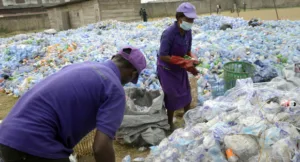
Image source: Bizwatch Nigeria
Other recycling-tech startups like Sustainable African Solutions Limited and Lumos Labs demonstrate what is possible. Lumos Labs built a pilot biodigester for a poultry farm that converts 200 kg of raw poultry manure into 62.5 kWh of clean electricity per day while also producing organic liquid fertiliser as a by-product. Sustainable African Solutions collects organic waste from restaurants and markets, reprocessing it into biogas and compost.
See a Related Post: Solar Startup Ecosystem Booming in Nigeria Amid Electricity Crisis
Navigating the Challenges: The Realities on the Ground
While the opportunities are vast, African entrepreneurs must navigate rough terrain. The infrastructure for waste management remains underdeveloped, and public awareness is still low. In Lagos, only 12% of households currently participate in organised recycling programs.
Logistics is a painful bottleneck. Pushing wheelbarrows through narrow, congested spaces is slow and inefficient, and collectors often earn paltry wages which can deter long-term retention. Furthermore, the recycling industry has limited domestic processing capacity. Many startups note that the machinery available locally is not adequate for efficient operations, forcing reliance on expensive imports.
There is also the challenge of inconsistent enforcement. While the EPR law is national, its application often varies between states, and previous bans on single-use plastics have suffered from poor enforcement. For a tech startup, this means a business model must be robust enough to be profitable even when the law is lax, turning a “nice-to-have” into a “must-have” for clients through efficiency and cost savings.
A Roadmap for the African Recycling-Tech Founder
To succeed in this space, founders should consider the following lessons drawn from early movers:
1. Don’t Reinvent the Wheel, Learn to Digitise: The informal collectors are already there. Companies like Pakam succeed because they turn existing waste pickers into trained, verified agents rather than trying to replace them. Your tech should empower the “cart pushers” with digital wallets and safety gear.
2. Collaborate, Don’t Just Compete: View large manufacturers not as competitors but as bank clients. Offer them a way to meet their EPR obligations. Scrapays actively works with regulatory bodies, viewing itself as a collaborator that complements government efforts.
3. Monetise Beyond the Waste: The money is often in the by-products. The organic fertiliser produced by a biogas plant can be commercially sold, and the carbon emissions you prevent can be monetised as carbon credits annually, creating a secondary revenue stream.
Lastly, waste is no longer a sign of poverty or lack of development; it is the raw material for the green industrial revolution. Nigeria is at a tipping point where environmental reality and technological innovation must meet to tackle its mounting waste problem. The billion opportunity is not in the distant future, it is here and now, waiting for startups daring enough to try.