
When you purchase through links on our site, we may earn an affiliate commission. This doesn’t affect our editorial independence.
Nvidia has launched the Rubin platform, a new collection of six chips designed to enhance large-scale AI supercomputing infrastructure. This new collection adds to the list of Nvidia’s ingenious products that became the powerhouse of supercomputing.
The system includes the Vera CPU, Rubin GPU, ConnectX-9, NVLink 6 Switch, SuperNIC, BlueField-4 DPU, and Spectrum-6 Ethernet Switch.
Nvidia intends to launch the platform in the latter half of 2026, as hyperscalers such as AWS, Google Cloud, Microsoft, and Oracle Cloud have declared their intentions to incorporate Rubin-based systems.
Microsoft will implement the Vera Rubin NVL72 rack-scale systems in its upcoming Fairwater AI data centres. Rubin’s design relies on the integrated collaboration of compute, networking, and storage hardware.
Nvidia claims that this method decreases token generation costs by as much as ten times and lowers the GPU requirements for training mixture-of-experts models by four times compared to its earlier version, Blackwell. The platform has been named in honour of astronomer Vera Florence Cooper Rubin.
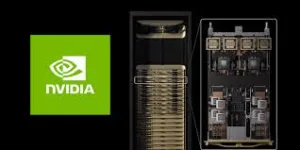
Image source: Nvidia
The Rubin package consists of two primary system setups, one is the Vera Rubin NVL72, which consists of 72 GPUs and 36 CPUs per rack. The other is the HGX Rubin NVL8 server board, featuring eight linked GPUs for x86-centric generative AI.
The Rubin GPU features a third-generation Transformer Engine with hardware-accelerated adaptive compression, providing up to 50 petaflops of NVFP4 processing power for inference tasks.
Nvidia’s sixth-generation NVLink provides 3.6TB/s bandwidth for each GPU and 260TB/s at the rack level, facilitating high-speed communication for substantial models.
The Vera CPU includes 88 custom cores that are compatible with Armv9.2 and offer direct NVLink-C2C connectivity.
Enhanced with Confidential Computing
The Vera Rubin NVL72 systems safeguard data throughout all processing platforms using third-generation Confidential Computing, enhancing security and reliability. The system uses real-time health monitoring and fault tolerance, leveraging a second-generation RAS engine.
BlueField-4 DPU offers Advanced Secure Trusted Resource Architecture (ASTRA) for managing extensive AI ecosystems.
Networking advancements feature the Spectrum-6 Ethernet Switch, which uses 200G SerDes technology with co-packaged optics tailored for AI tasks.
Spectrum-X Ethernet Photonics enhances reliability and energy efficiency while enabling long-distance distributed features within a unified AI ecosystem.
Check out Other Posts on this Site
CoreWeave to Adopt Rubin-based Infrastructure
Pioneering companies like CoreWeave intend to adopt Rubin-based infrastructure beginning in late 2026.
Server providers Cisco, HPE, Lenovo, Dell Technologies, and Supermicro will provide systems compatible with Rubin.
Research laboratories such as Anthropic, OpenAI, Meta, and Mistral AI plan to use the platform for bigger models and reduced latency.
OpenAI’s CEO, Sam Altman, stated: “Intelligence increases with computing power.” By increasing computational power, models become more capable, tackle more complex problems, and help more people. The Nvidia Rubin platform enables us to continue expanding this advancement so that superior intelligence serves everyone’s needs”.
Also, Red Hat has broadened its partnership with Nvidia to deliver an optimised software stack that includes Red Hat Enterprise Linux, OpenShift, and Red Hat AI products that will be Rubin-based.