
LG Electronics took the stage at CES 2026 to unveil its most groundbreaking innovation, LG CLOiD. This innovation clearly brings science fiction much closer to our daily reality. The South Korean technology giant unveiled LG CLOiD, a humanoid domestic robot designed around its “Zero Labour Home” concept. This humonoid robot can not only clean your floors but also prepare your meals, handle laundry (including folding), and manages dishes and other tasks. This is an important gadget that can help save you a lot of time while you concentrate on other priorities.
Also, it is equipped with cutting-edge AI, agile arms, and advanced smart-home compatibility, CLOiD aims to transform the concept of “zero-labor home” entirely. This could be ushering in a new future where robots carryout all of our regular household chores.
LG’s Zero Labour Home Concept Materialized Through CLOiD
LG CLOiD, an AI-driven home robot made its public debut at CES 2026. Designed to oversee and streamline daily household activities through smart devices, CLOiD seeks to reduce both the time and physical effort required for regular chores. The robot demonstrates LG’s steadfast commitment to advanced home robotics. The company is integrating its Self-Driving AI Home Hub technology with the broader LG ThinQ smart home ecosystem to provide a more hands-free lifestyle to its customers.
At CES 2026, LG showcased CLOiD across various simulated home environments, demonstrating its real-world applications. In a demonstration, the robot prepares breakfast by retrieving milk from the fridge and placing a dish in the oven. Once people leave the home, CLOiD automatically transforms into task mode, performing laundry and removing laundry after drying, and neatly folding and arranging items. Also, the simulations demonstrated the robot’s ability to recognise everyday activities, comprehend user requirements, and effectively manage connected devices without requiring manual intervention.
Visitors to CES 2026, which took place from January 6 to 9 got to experience CLOiD at LG’s booth #15004 in the Las Vegas Convention Centre. There, the company showcased its range of Zero Labour Home concept that suggest a potential for drastic changes in domestic living in the near future.
See Other Posts on this Site
LG Upgrades Their 2025 TVs With Five New AI Features
Norwegian Company, 1X Develops World’s First Commercially Viable Humanoid Robot Cleaner and Butler
Examining LG CLOiD’s Humanoid Design and Cognitive Abilities
LG CLOiD features a human-like design, purposefully designed for practical home settings. The robot has a head unit attached to a torso with two fully movable arms, all of which are backed by a wheeled base that can navigate autonomously.
Also, its height-adjustable torso can tilt and move, enabling CLOiD to easily access objects from knee height to elevated areas, such as countertops and shelves, making it handy for daily activities around the house.
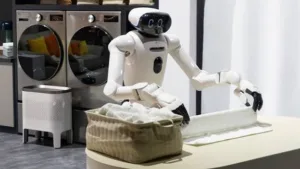
Image source: endgadget.com
Also, every robotic arm replicates the adaptability of a human limb, providing seamless mobility at the shoulder, elbow, and wrist. This degree of motion allows for movement forward, backwards, rotation, and side-to-side, with the hands featuring five independently functioning fingers for precise manipulation of objects. Collectively, these features enable CLOiD to grasp, raise, and handle a diverse range of household objects, whether it’s dealing with dishes in the kitchen, overseeing laundry, or aiding in communal living areas.
Mobility is derived from a wheeled platform driven by autonomous driving technology, created using LG’s expertise in robot vacuums and the Self-Driving AI Home Hub. The slim design maintains a low centre of gravity, improving stability and safety while minimising the risk of tipping. This design is necessary for households with children or pets. The wheeled design provides an economical and dependable method for the robot to transition seamlessly between rooms.
At the top, CLOiD’s head serves as the control center. It contains the robot’s central processing unit, alongside a screen, speaker, cameras, and multiple sensors, all powered by voice-driven generative AI. These elements facilitate organic interaction through verbal responses and vivid visual cues, while also enabling the robot to perceive its environment, understand household patterns, and intelligently control linked devices.
The Artificial Intelligence System that Powers LG CLOiD
CLOiD’s complete system is driven by LG’s Physical AI technology, integrating sophisticated perception and action models. A Vision Language Model (VLM) transforms visual inputs, like images and videos, into organised, language-oriented comprehension. In contrast, Vision Language Action (VLA) translates visual and verbal directives into accurate physical actions. The development of this technology required extensive training on thousands of hours of household task data. This robost training enable CLOiD to identify appliances, understand user intentions, and perform contextually appropriate actions such as opening doors, relocating items, or effectively managing chores throughout the home.
Also, CLOiD gets even greater capabilities when combined with LG’s extensive smart home ecosystem, featuring the ThinQ AI Home Platform and the ThinQ ON hub. This thorough integration enables the robot to seamlessly interact with and manage various connected appliances, seamlessly transforming separate smart devices into a cohesive system. The outcome is a more reactive home where CLOiD can oversee, arrange, and enhance household activities throughout LG’s product range, transforming its function from a supportive aide to a primary coordinator of the connected home.
“The LG CLOiD home robot is created to intuitively interact with and comprehend the people it assists, delivering an enhanced degree of home assistance,” stated Steve Baek, president of the LG Home Appliance Solution Company, in a statement.
“We will continue our relentless efforts to achieve our Zero Labour Home vision, making housework a thing of the past so that customers can spend more time on the things that really matter.”
The Rise of Humanoid Robots
In 2025, humanoid robots hit a tipping point. Foundation models for robotics matured, hardware got cheaper and better, and companies investored more in this sectors. Also, late last year, a Norwegian company, 1X developed the world’s first commercially viable humanoid robot.
Competition between big tech companies remain stiff as each tries to roll out the first humanoid robot that will become a common household equipment.