
Nigeria is a country of over 200 million people, with a rapidly growing population. This rapid growth creates a huge challenge around how the country produces enough food for everyone. Traditional farming, which depends on large areas of land, rain, and good soil, is struggling. Climate change brings irregular rainfall, floods, droughts, and heat that destroy crops. At the same time, good farmland is shrinking because of building projects, soil degradation, security challenges and other problems.
Vertical farming offers a smart and promising solution. It is a modern way of growing crops in stacked layers inside buildings or special structures, using very little land and water. For young Nigerians who want to start businesses, vertical farming presents big opportunities to make money, create jobs, and help solve our country’s food problems.
Understanding What Vertical Farming Is
Vertical farming is different from the farming our parents and grandparents know. Instead of spreading plants across a big field, farmers grow them upwards on shelves or towers. Vertical farming is the practice of growing crops in vertically stacked layers rather than in a flat, single layer on a traditional field.
To survive without a standard plot of land, startups use Controlled Environment Agriculture (CEA). This means the plants are kept indoors—inside warehouses, repurposed shipping containers, or specially built greenhouses—where temperature, humidity, and light are completely managed.
Most vertical farms use one of three soilless growing systems:
1. Hydroponics: Plants grow in a water solution mixed with liquid nutrients. This accounts for nearly half of the vertical farming setups globally.
2. Aeroponics: Roots hang in the air and are automatically misted with a nutrient-dense spray every few minutes. Plants grow under special LED lights that act like sunlight. Computers and sensors control temperature, water, and nutrients.
3. Aquaponics: A closed loop where fish are raised in water tanks. The fish waste is converted into natural fertiliser for the plants, and the plants clean the water before it loops back to the fish.
Vertical farming ensures that crops can grow all year round, even during the dry season or heavy rains. Vertical farms can be set up in warehouses, on rooftops, in shipping containers, or in empty buildings in the city.
Why Vertical Farming Makes Sense for Nigeria
Nigeria faces several problems that vertical farming can solve. Some include:
1. Urbanisation and land shortage: Many cities have little space for traditional farms, but plenty of empty buildings and rooftops. Vertical farming turns these spaces into productive farms close to where people live.
2. Climate challenges: With unpredictable weather, droughts in the north, and floods in other areas, traditional farms often fail. Vertical farms are indoors, so weather outside does not matter. Farmers can produce food steadily.
3. Water scarcity: Traditional farming uses a lot of water. Vertical farming can save up to 90-95% of water by recycling it. This is very important in the dry parts of Nigeria.
4. Food security and imports: Nigeria spends a lot of money importing food like tomatoes, vegetables, and rice. Vertical farms can produce fresh vegetables locally, reduce imports, and make food cheaper and fresher.
5. Youth unemployment: Many young Nigerians are educated but without good jobs. Vertical farming is a tech-based business that can attract young people who like technology, business, and agriculture.
Huge Market Opportunities for Startups In Vertical Farming
The case for indoor vertical farming in Nigeria is anchored heavily in current economic realities. Startups entering this space are stepping into a market hungry for disruption due to several critical pressure points:
1. Rapid Urbanisation and Shorter Supply Chains
Nigeria’s major cities are swelling. Lagos alone grows by thousands of residents daily. As cities expand, arable land near urban centres shrinks, forcing traditional farms further into rural areas.
Currently, a basket of tomatoes or vegetables harvested in northern states like Kano must travel hundreds of kilometres via poorly insulated trucks to reach markets in the south like Lagos or Port Harcourt. Because of bad roads, traffic congestion, and a complete lack of cold-chain refrigeration, a staggering 40% to 50% of perishable food spoils before it ever reaches a consumer’s plate. Vertical farming allows startups to place farms directly inside urban neighbourhoods—in old warehouses or on rooftops—cutting transport times from days to mere minutes.
2. Climate Change and Unpredictable Seasons
Traditional Nigerian agriculture is highly exposed to the elements. Erratic rainy seasons, sudden prolonged droughts, and severe flooding routinely wipe out crop yields. For instance, data from the Nigerian Meteorological Agency (NiMet) highlights continuous variability in annual rainfall patterns that disrupt traditional planting schedules.
Because vertical farms are completely enclosed, weather becomes irrelevant. A startup can reliably grow crops 365 days a year, unaffected by harmattan haze, heavy downpours, or blistering heatwaves.
3. Skyrocketing Food Imports and Currency Pressures
Nigeria relies heavily on agricultural imports to feed its population, spending trillions of Naira annually on food items. With high inflation and fluctuations in the foreign exchange market, the cost of importing foreign produce continues to climb.
Supermarkets, high-end hotels, and urban restaurants are actively looking for local alternatives that can match international standards for quality and cleanliness. Startups that can grow premium produce locally can capture this massive market spend.
Government Support and Policies Towards Vertical Farming
The Nigerian government is paying more attention to modern agriculture. The National Agricultural Technology and Innovation Policy (NATIP) supports digital and climate-smart farming. Some state governments, like Lagos, offer grants to agritech startups. There are also partnerships with organisations promoting vertical farming, such as training centres and demonstration projects.
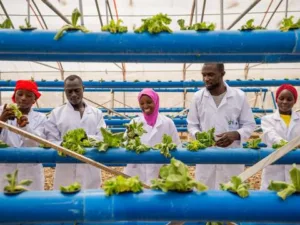
Image source: The Technology Center
Founders wanting to venture into vertical farming can apply for loans, grants, and support from programs aimed at youth and women in agribusiness. Private investors and development partners are also showing interest in green technologies.
Real Examples Of Successful Vertical Farming In Nigeria
Several projects show that vertical farming works in Nigeria. Several hydroponic setups in Lagos and Abuja are already producing lettuce and herbs for restaurants and shops. Some of them include:
- Soilless Farm Lab trains young people and runs successful soilless farming operations.
- Wells Hosa Greenhouse Farms in Edo State uses hydroponics on a large scale for tomatoes.
Also, partnerships with international groups are setting up training and demonstration centres across the country.
These examples prove that with the right approach, vertical farming can succeed despite local challenges.
Also Read: Vast Opportunities Awaiting Recycling-Tech Startups As Waste Mounts Across Nigeria
Challenges And Bottlenecks Startups Must Face Doing Vertical Farming In Nigeria
While the prospects are incredibly exciting, vertical farming in Nigeria is not a hands-off, get-rich-quick business. It comes with steep local hurdles that require creative problem-solving.
1. Inadequate Power Supply
Vertical farms require constant electricity to power water pumps, automated timers, and LED grow lights. Relying entirely on Nigeria’s national grid is a recipe for business failure due to frequent blackouts. Operating 24/7 on traditional diesel generators is also prohibitively expensive, eating up any potential profit margin.
To surmount this problem, Nigerian startups are advised to design their infrastructure around renewable energy. Combining solar power installations with energy-efficient LED systems keeps operational costs manageable and predictable.
2. High Initial Setup Costs
Importing specialised vertical farming racks, automated nutrient dosers, and sensor tracking systems is expensive. A commercial indoor hydroponic setup can range anywhere from ₦1.5 million to over ₦10 million depending on scale. Gathering this seed capital is tough for young entrepreneurs given the high local interest rates on bank loans.
The solution involves moving toward modular, local fabrication. Startups are building their own vertical racks using locally sourced wood, PVC pipes, and locally welded metal frames, reserving import budgets only for essential tech like pH sensors and specific grow lights.
3. Technical Skills Deficit
Vertical farming is a blend of agronomy, engineering, and data tracking. Knowing how to maintain precise nutrient formulas, manage water acidity (pH levels), and spot indoor mould requires specialised training that isn’t typically taught in standard regional agricultural courses.
Practical Paths to Profitability
For an agri-tech startup looking to break even within a reasonable 18-to-24-month window, three clear business models are proving effective in the local market:
1. The B2B Supply Model
Targeting the top tier of urban food buyers. This involves signing direct supply contracts with major supermarket chains, boutique grocery stores, hotels, and upscale restaurants. These buyers value two things above all else: uncompromising consistency and zero pesticide use. Because vertical farms don’t use soil, they eliminate soil-borne pests and the need for chemical sprays, allowing startups to brand their food as pure, clean, and locally grown.
2. Farming-as-a-Service (FaaS) and Tech Installation
Some startups choose not to sell vegetables at all. Instead, they sell the technology. They act as contractors who install mini-vertical hydroponic systems on home balconies, hotel rooftops, or school compounds, earning money from setup fees and ongoing maintenance contracts or nutrient solution deliveries.
3. Outgrower Network Aggregation
A startup can set up a central, highly advanced “hub” farm where they sprout seeds and mix premium nutrient solutions. They then distribute small, low-cost vertical kits to urban homeowners or smallholder families (the outgrowers). Once the crops mature, the central startup buys back the produce, aggregates it, and sells it to big buyers—creating an ecosystem that scales up production without requiring the startup to buy massive warehouses.
Vertical farming in Nigeria is transitioning out of the experimental phase and turning into a viable commercial industry. It matches the ambitions of Nigeria’s tech-forward youth population, offering a way to participate in agriculture without the gruelling manual labour or land ownership barriers of traditional farming.