
Nigerian Non-Fintech Startups: The Unbreakable Playbook for Conquering Compliance
The dominant narrative across the African tech ecosystem suggests that building a successful startup is exclusively a financial game. Venture capital inflows heavily favor platforms that process payments, issue cards, or facilitate cross-border remittances. This is because financial technology dominates the market share; and regulators like the Central Bank of Nigeria (CBN) have built dedicated regulatory sandboxes. These environments give payment applications a soft landing pad, clear policy roadmaps, and structured paths to scale. However, what happens if your business moves physical packages through congested urban corridors or handles delicate medical patient records? If you build outside the financial sphere, you quickly realize there is no regulatory cushion waiting to absorb your operational risks.
Building Nigerian non-fintech startups in spaces like healthtech, logistics, cleantech, or agritech means operating on maximum difficulty from day one. You are dealing with real-world infrastructure gaps, high operational friction, and fragmented state laws while facing the same strict corporate oversight as heavily funded software giants. Unlike venture-backed payment institutions, early-stage consumer and enterprise applications lack the massive capital reserves required to retain expensive law firms or maintain internal compliance teams. Unfortunately, regulatory authorities do not offer discounts for lean operational runways.
Read Also: 5 Emerging African Startups Solving Local Problems Right Now
To survive and build an enduring business in this challenging climate, founders must undergo a fundamental mindset shift. Compliance cannot remain a late-stage corporate milestone deferred until a Series A funding round. Instead, navigating institutional frameworks must become a core product feature integrated directly into your daily software architecture and operational execution. This is the definitive strategy for building an institutional framework capable of outsmarting administrative bottlenecks for Nigerian non-fintech startups.
1. Demystifying the Base Regulatory Framework for Nigerian Non-Fintech Startups
Operating a corporate entity in Nigeria requires a clear, granular understanding of the foundational legal terrain before attempting to scale. Every company begins its journey at the Corporate Affairs Commission (CAC), registering under the Companies and Allied Matters Act (CAMA) 2020.

While registering a Private Limited Company (Ltd) is a straightforward administrative hurdle, maintaining active registration status is an ongoing operational challenge. The commission has significantly intensified its enforcement mechanisms, regularly issuing public notices targeting unregistered operating entities and imposing strict deadlines for annual return filings. Failing to file your mandatory annual returns within forty-two days of an Annual General Meeting results in continuous daily fines and places the entity at risk of being permanently struck off the corporate register, with no exception to Nigerian non-fintech startups.
Beyond basic corporate registration, navigating tax localization requires deep engagement with the Federal Inland Revenue Service (FIRS) and respective State Internal Revenue Services. Under the recent Tax Reform Acts of 2025, there is clear fiscal relief designed to protect early-stage operations. The statutory threshold completely exempts small companies with an annual gross turnover of ₦50 million or less from paying Company Income Tax (CIT), Capital Gains Tax (CGT), and the newly introduced 4% Development Levy. This structural buffer protects the early runway, but claiming this 0% tax status remains entirely conditional on filing accurate annual returns on time. If poor bookkeeping mistakenly lumps non-revenue inflows, such as founder loans or equity investments, into the gross turnover column, your company can accidentally breach the ₦50 million threshold, triggering severe tax liabilities.
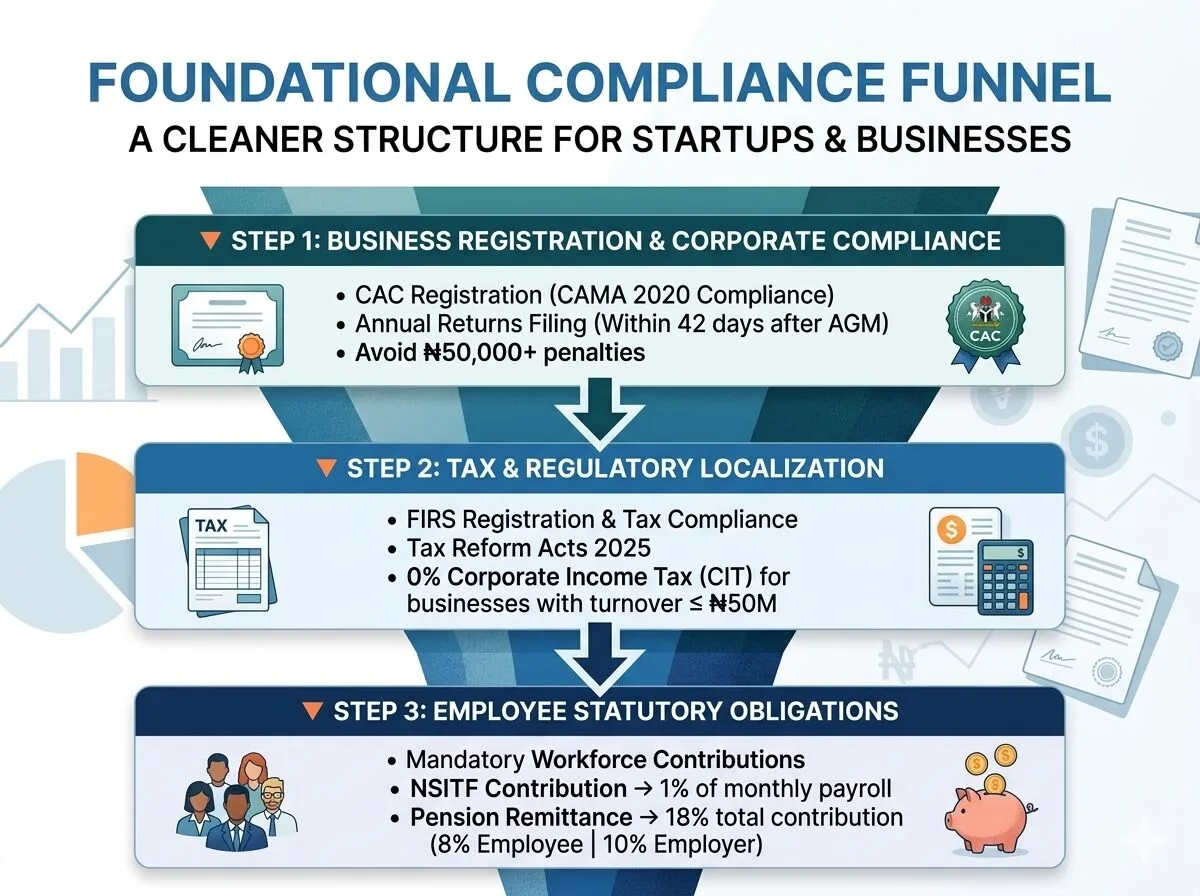
Simultaneously, managing internal human resources introduces mandatory statutory costs that lean teams often overlook. Employers must contribute 1% of the total employees’ monthly payroll to the Nigerian Social Insurance Trust Fund (NSITF) annually. Additionally, under pension guidelines, companies must handle monthly remittances comprising an 8% employee deduction and a 10% employer contribution. These funds must reach an approved Pension Fund Administrator (PFA) within seven days of salary payments. For Nigerian non-fintech startups and fintech startups alike, neglecting these foundational allocations creates severe liabilities that frequently derail institutional investor due diligence during later fundraising rounds.
2. Navigating the Data Liability Traps Endured by Nigerian Non-Fintech Startups
Data privacy regulation is an operational reality that hits consumer apps far faster than traditional software companies expect. Any Nigerian non-fintech startups or other businesses handling personal user data must align their platform architecture with the strict mandates of the Nigeria Data Protection Act (NDPA). Under the implementation guidelines enforced by the Nigeria Data Protection Commission (NDPC), organizations classified as Data Controllers or Processors of Major Importance face intense administrative requirements. This classification applies to any entity processing large volumes of personal information or managing highly sensitive user data, including biometric details, home addresses, or financial records.
| Operational Dimension | The Fintech Venture Playbook | The Non-Fintech Reality |
| Regulatory Frameworks | Structured CBN Sandboxes | Direct Liability to CAMA/NDPA |
| Data Audit Triggers | Automated via Bank Verification Number | Highly Fragmented User Data Logs |
| Capital Allocation | Institutional Funds for Compliance | Lean Bootstrapped Budgets |
| State-Level Friction | Handled via Central Digital License | Multi-Jurisdictional Local Levies |
The primary challenge lies in the mandatory filing of the annual Data Protection Compliance Audit Return (CAR). The NDPC enforces strict deadlines for these submissions, such as the extended window closing on May 30, 2026, for the 2025 audit cycle. Missing this statutory window carries severe financial consequences, including a mandatory late-filing penalty equivalent to 50% of the standard filing fee, alongside targeted enforcement actions and heightened regulatory scrutiny. For an early-stage healthtech platform tracking patient vitals, a logistics startup mapping real-time driver locations, or any Nigerian non-fintech startups crossing the user thresholds that trigger these audits, this happens rapidly, bringing unexpected administrative compliance expenses long before achieving clear profitability.
Read Also: Why Startups Founded By Diaspora Returnees Often Succeed in Africa
To mitigate this burden, engineering teams of these Nigerian non-fintech startups must adopt data minimization principles directly within their core software code. If your system avoids collecting or storing non-essential personal identifiers, your operating model reduces its overall data liability footprint. Platforms should conduct internal data mapping exercises to document precisely how information flows through their infrastructure, where it is stored, and which third-party APIs can access it. Restricting data collection exclusively to variables required for core service delivery allows early-stage companies to legally delay hitting expensive compliance audit tiers while ensuring robust operational security.
3. Overcoming Cross-Border and Inter-State Logistics Barriers Without Regulatory Cushions
Moving physical goods across state lines exposes logistics, e-commerce, and agritech platforms to highly fragmented municipal regulations. While a digital financial application processes cross-border transactions seamlessly via standardized APIs, a physical delivery truck encounters varying localized government levies, transit permits, and state-level haulage taxes. Every sub-national jurisdiction enforces unique operational demands, creating severe friction for transportation networks trying to maintain predictable unit economics across regional supply chains.
Furthermore, scaling these operations into neighboring West African markets introduces complex cross-border trade policies and customs clearing frameworks. Startups expanding their distribution networks beyond domestic borders face intense administrative scrutiny, currency fluctuations, and varying import-export documentation requirements. Navigating these constraints without the backing of institutional legal departments requires deep collaborative operational frameworks. Founders must leverage strategic partnerships with established local market distributors, utilizing shared logistics infrastructure to distribute compliance costs across multiple ecosystem participants.
This structural friction demands clear cost-optimization strategies. Successful operators avoid asset-heavy models early in their lifecycle, choosing instead to integrate with existing localized warehousing systems and third-party transport guilds. Upon embedding compliance management directly into regional partner contracts, expanding platforms can scale efficiently across multiple territories. This approach allows companies to avoid the prohibitive capital expenditures typically required to secure independent operating licenses in new jurisdictions.
4. Designing a Capital-Efficient Legal Roadmap Adapted for Nigerian Non-Fintech Startups
Building a resilient corporate structure, be it fintech startups or Nigerian non-fintech startups, on a lean budget requires avoiding the traditional model of retaining full-time corporate legal counsel. Early-stage enterprises must utilize fractional legal service models and modern compliance automation platforms to manage their statutory obligations cost-effectively. Partnering with technology-focused legal firms allows companies to access specialized regulatory expertise on a flexible, project-based arrangement, preserving vital cash reserves for product development and user acquisition.
Additionally, deploying cloud-based compliance tools simplifies tracking recurring corporate milestones, such as filing CAC annual returns, remitting monthly withholding taxes, and executing pension allocations. Automating these administrative workflows minimizes human error, ensuring your platform never incurs preventable late-filing penalties or faces sudden operational shutdowns. Maintaining organized, auditable corporate documentation ensures your enterprise remains perpetually attractive to institutional investors, who closely examine regulatory compliance histories during capital injection rounds.
Integrating statutory financial management with clear accounting processes functions as an excellent operational growth mechanism. While maintaining accurate, transparent financial records, you can effortlessly prove your true annual turnover figures to tax authorities, safely preserving your small-business tax exemptions. This meticulous approach protects your runway from sudden, aggressive tax audits while presenting a highly credible, institutional-grade business model to international venture partners.
5. Nigerian Non-Fintech Startups: Building Long-Term Operational Resilience in the Evolving African Tech Ecosystem
The digital landscape across Africa is undergoing a period of intense regulatory formalization. Government agencies are rapidly expanding their oversight capabilities, moving decisively past financial applications to actively monitor the wider tech ecosystem. This regulatory shift means long-term market success will belong to software companies, including but not limited to Nigerian non-fintech startups that design adaptable, legally resilient operational frameworks from their inception.
Transitioning compliance from an administrative burden into a core competitive advantage allows expanding platforms to build deep consumer trust and scale smoothly across new geographic territories. Embracing proactive regulatory management safeguards your enterprise from unexpected legal disruptions, creating a highly sustainable foundation for long-term commercial growth. The future champions of the regional digital economy will be defined by their ability to write excellent software code while seamlessly masterminding complex regulatory environments.