
iAsk has launched an AI Video Tutor that offers real-time assistance, enabling students to engage deeply with problems rather than just receiving quick answers. Unlike traditional AI tools, which deliver transactional responses, this video tutor provides step-by-step verbal and visual explanations.
As students move through questions, they can easily interrupt, request clarifications, or delve deeper into topics, creating an interactive and engaging learning experience that is nearly undistinguishable from human tutoring.
This tool is specifically designed for subjects like math, science, writing, and research. Its verbal and visual delivery helps students, particularly visual and auditory learners, better comprehend concepts by focusing on the reasoning behind ideas rather than just retrieving answers. The AI tutor reduces pressure on students, allowing them to ask follow-up questions freely, which encourages a more thorough understanding of the material.
With 75% of its users being Gen Z students who are typically short on patience and intolerant of errors, iAsk prioritises accuracy and reliability, emphasising detailed explanations and reasoning in its video tutorials.
iAsk: Tested and Acclaimed by Thousands of Users
Over 22,000 students have interacted with this feature, which caters to a range of usage—from quick clarifications to in-depth problem-solving sessions. Notably, students who use the video option on iAsk tend to engage with the content for longer.
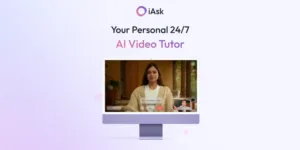
Image source: Techtimes
While the video tutor is included in the currently free iAsk Pro and aims to be accessible to all students, it acknowledges that not every learner prefers video. The platform retains flexibility, allowing students to choose text or video based on their preferences.
Overall, this represents a significant shift in educational AI, focusing on improving the quality of explanations rather than just speeding up the delivery of answers.
Prism: The New Science and Research Workspace by OpenAI
In a related development advancing science and academia, OpenAI has launched Prism, an AI-powered workspace for scientific research built on the GPT-5.2 model. Accessible via ChatGPT accounts, this cloud platform allows unlimited projects and collaborators, aiming to facilitate scientific research.
Prism is backed by the Crixet platform, and offers tools for research, particularly in fields like mathematics and computational biology.
Despite this ambitious push into science, OpenAI continues to navigate significant external challenges. The company faces escalating legal and financial pressures, most notably a high-stakes lawsuit from co-founder Elon Musk, who alleges it abandoned its nonprofit mission and seeks damages potentially exceeding $100 billion. These hurdles, alongside concerns over citation accuracy and data privacy in Prism, underscore the complex landscape in which OpenAI is attempting to transform both AI capabilities and scientific practice.